From Control to Emergence
What if, for once, everything went well?
September 23, 2026
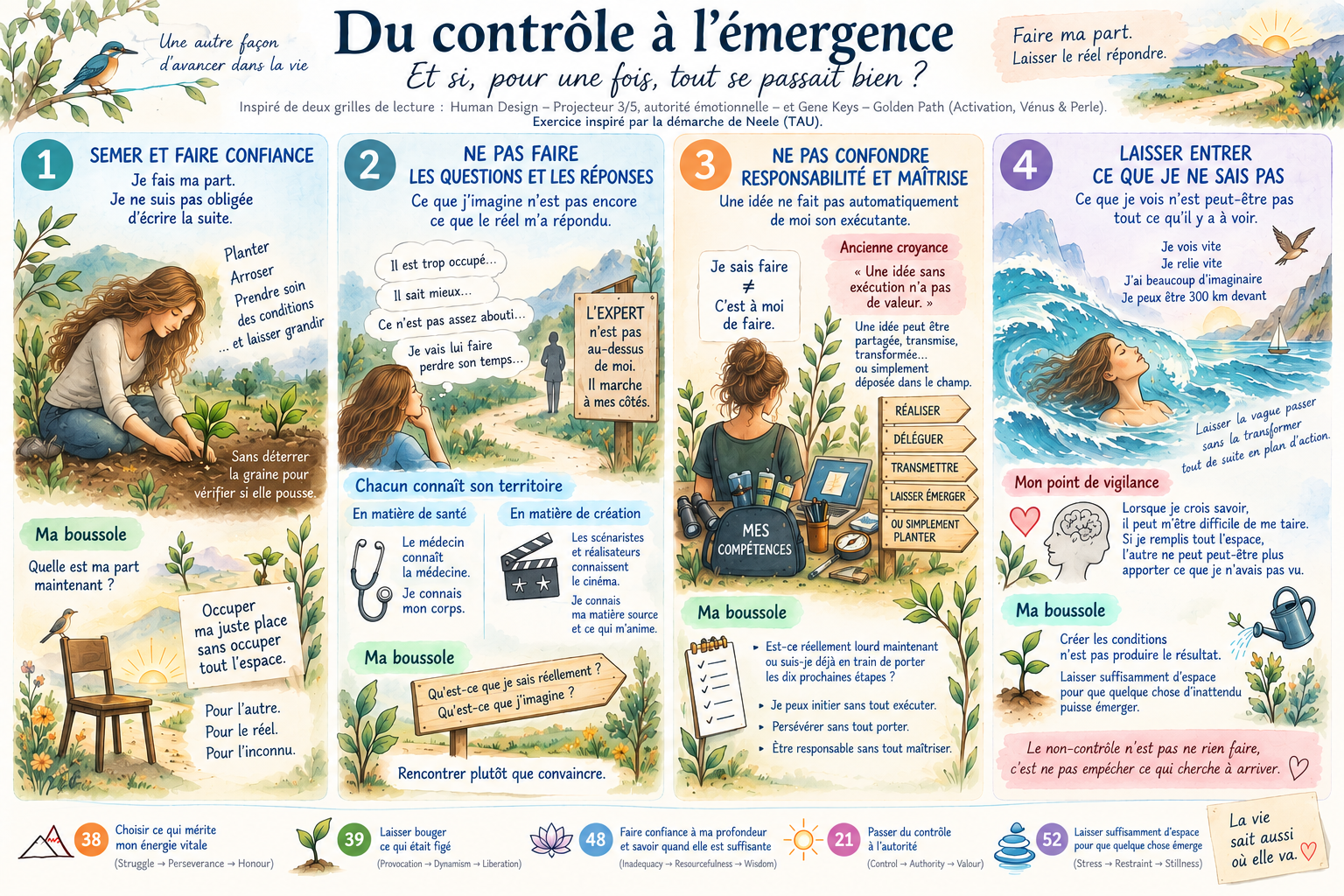
I recently undertook a small exercise in personal mapping.
The starting point was not actually mine. Someone close to me, Neele, with whom I share the TAU experience, had created a beautiful map around her communication: “Meeting myself more fully so I can connect more fully.”
Her approach inspired me. Not to reproduce her map — it belongs to her — but to use the same principle: to begin with very concrete situations, look at what activates me or makes me slightly uncomfortable, and see whether a thread emerges.
For this, I used two interpretive frameworks that I know and find interesting: Human Design and the Gene Keys. I do not consider them truths to which one should conform, but possible mirrors. We look. We keep what resonates. We leave the rest.
And one theme emerged quite clearly: from control to emergence.
Doing my part without writing the whole story
For a long time, I was very good at anticipating. Seeing quickly. Making connections quickly. Imagining what an idea might become. Being, at times, as I have already been reproached for in leadership, 300 kilometres ahead of everyone else.
That was a tremendous strength in my life as an entrepreneur. But a strength used automatically can also become a trap.
An idea appears and, almost immediately, I can see the next ten steps. And then two opposite reactions become possible: I take everything on, or I give up before I have even begun — “this is going to be so burdensome again.”
In both cases, I close the circle myself.
Not digging up the seed to check whether it is growing
The image that comes to me is that of a seed. I can plant it, water it, care for the conditions in which it will be able to grow.
But if I dig it up every morning to check whether it has sprouted, I risk preventing precisely what I am trying to bring about.
Creating the conditions is not producing the outcome. Non-control does not mean “doing nothing.” It means doing very precisely what is mine to do now, and then knowing when to stop.
I recently experienced this in a laborious administrative process. Instead of giving up, I broke the process down into stages — one step, one response, a new piece of information, the next step. I did my part for long enough to allow reality to answer me, without involving my business partner in every intermediate stage.
A decision is now hers to make. I can present it to her and return her share of the responsibility to her.
Neither carrying everything. Nor abandoning everything.
Taking my rightful place
Behind all this was an old entrepreneurial belief: “an idea without execution has no value.”
An idea came to me, it was good, so it had to be carried out — and since it had come to me, who was supposed to take care of it? Me, by default.
Today, I see things differently. An idea can be good without my being the person who has to implement it. It can be set down, shared, passed on, taken up by someone else — or become nothing at all. That takes nothing away from what it brought me.
The same is true of skills. Because I know how to do something, I am not obliged to do it.
Ability does not create obligation.
This question of place runs through a great deal of my life. I see quickly, I make connections quickly, I have a vivid imagination — and when I am enthusiastic, ideas come even faster.
It is not necessarily a desire to convince. It is often simply enthusiasm. But even sincere enthusiasm can fill all the space.
If I immediately lay down everything I see, everything I connect, everything I imagine, the other person may no longer be able to bring what I had not seen.
Conversely, if I consider that the other person knows better, is more legitimate or more expert, I may surrender to them a place that belongs to me.
In both cases, something falls out of balance.
What I am learning, then, is neither to take up more space nor to take up less.
It is subtler:
taking my rightful place without taking up all the space.
Saying what I have to say. Then breathing.
Leaving a blank page. Letting an answer arrive. Letting in what I do not know.
Not asking the questions and giving the answers
Another way of controlling is to answer for ourselves the questions that reality has not yet settled.
They must be too busy. My idea is not developed enough. They probably will not be interested.
This is particularly easy when facing someone I consider an expert. I can very quickly place them in a position above me: they know, I do not.
But stepping out of that position obviously does not mean reversing the roles and placing myself above them.
They are not above me. I am not above them. We simply do not have the same knowledge of the same territory.
The doctor knows medicine; I know my body.
Screenwriters and directors know cinema; I know my source material and what moves me.
The point, then, is not to decide who knows better, but to allow these different forms of knowledge to meet.
I do not need to arrive with a perfectly polished proposal and half the answer. I can also meet. Show. Ask:
“What do you see in this?”
And listen.
Without erasing what I see.
An empty chair for the unknown
It may be the image I like most in this map.
An empty chair.
Not because no one came — a chair deliberately left free.
For the other.
For reality.
For the unknown.
I do not need to know in advance who will sit there.
What if, for once, everything went well?
Not necessarily as I had imagined. Not because I had finally managed to foresee everything.
Perhaps even exactly the opposite: because I had left enough space for something to happen that I could never have foreseen.
And sometimes, the obstacle is not reality. It is me — an accumulation of habits.
Doing my part. And leaving the chair empty.