Absurdland — or the right to laugh at serious things
A story born in a drawer, transformed into an illustrated tale when an old imagination met a new tool — with laughter as a way of looking at our own hells.
Ever since I was little, I have loved telling stories.
I told them to my younger sisters. Later, to my children.
I was also raised on Franco-Belgian comics — they are part of my imagination, almost part of my cultural DNA.
Art and culture were present in my family history long before me. People drew buildings, but they also invented celebrations, characters and worlds.
My great-great-grandfather organised large cultural festivals in La Panne that were open to the public. There were also family celebrations inspired by the Middle Ages in which my parents took part, dressed as kings and queens of France, among other things. I was not there, but I saw them in their costumes. I thought it was magnificent.
All of that probably leaves traces.
I like observing human beings. Their contradictions. Their certainties. Their little habits and their grand strategies for power.
Not forgetting my own. I have enough self-mockery to know that I am part of the show.
A story sleeping in a drawer
In 2024, during a novel-writing lab, I wrote a somewhat improbable story set in Hell.
It was called Absurdland.
I did not really know what I would do with it. Probably nothing. I simply wanted to laugh — at our foibles, our certainties, our strange ability to reproduce the same behaviours everywhere, to the point that, in Absurdland, even Hell ends up looking uncannily like the world of the living.
Then the story went back into my drawers.
And artificial intelligence arrived.
When a new tool meets an old imagination
The story existed before the image. I had written the tale, invented the characters, their foibles, their dialogue, their little Hell.
And somewhere in my imagination since childhood, there were comics.
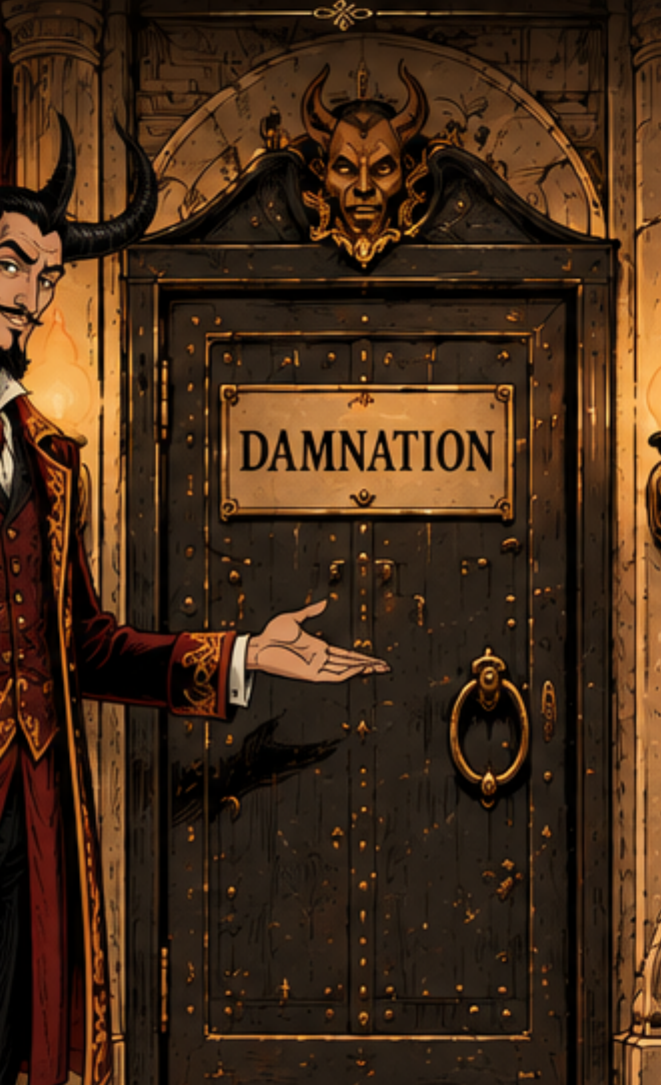
AI gave me a tool to bring the two together. I searched for my characters, built scenes, started again, moved things around, rewrote — and sometimes cursed, too, at a machine that had decided to do something entirely different from what I had asked.
Little by little, the 2024 story became an illustrated tale. Not quite the one I might have imagined at the time. But perhaps precisely because every creation also arises from the encounter between what we already carry and what we meet along the way.
And then I hesitated
When the time came to publish Absurdland, I wondered whether I truly dared.
Was it really reasonable to laugh at Hell, power and our foibles?
That hesitation brought me back to a broader question: what is a living culture?
Culture is not a society’s optional extra. It is one of the ways a society knows who it is.
At a time of extremely rapid economic, technological and social change, one question sometimes returns to me: what becomes of a society when it gradually loses the signs through which it recognised itself?
Keeping a living culture in circulation does not only mean preserving a heritage. It also means continuing to produce new signs — telling stories, drawing, joking, inventing, subverting, passing things on — and accepting that none of it will be perfectly consensual.
I like a culture that shifts our gaze. That sometimes provokes. That makes us laugh. And that preserves a few places where we can still create without having to be perfectly serious, perfectly correct, perfectly classifiable.
So I decided to publish Absurdland.
It is a satire. A slightly absurd illustrated tale. A way of laughing at ourselves and at that curious ability we have to unconsciously repeat what sometimes ends up creating our own hells.
Éditions du Grandala
In its own way, Absurdland also inaugurates Éditions du Grandala.
A publishing house that is still tiny, organic and artisanal — one that does not really have a catalogue, and above all has no ambition to already know what it will become.
Perhaps simply a place where singular voices, images, films, objects and works that might not necessarily have found a place elsewhere can appear.
Things that are a little invisible, in short.
Which, for the Grandala, seems rather fitting.
The first illustrated tale from Éditions du Grandala.
Enter Absurdland →