The middle way
For a long time, I have had an intuition that there is a third way: one that allows something alive to emerge from the encounter between two beings.
For a long time, I have had an intuition that there is a third way: one that allows something alive to emerge from the encounter between two beings.
A middle way.
Neither doing it alone.
Nor stepping into someone else’s project.
Nor asking someone to step into mine.
Nor merging.
Another way of creating, of working, perhaps even of being in relationship: co-creation in interdependence.
This conviction is not new.
What is new is that I am beginning to understand why, despite this intimate conviction, I found it so hard to live.
I was still trying to bring this third way into being with the tools of the old paradigm.
Making visible what I could see
I have always had many ideas.
I easily see connections between things that, on the surface, have none. I perceive possibilities before they take concrete form.
But a difficulty appeared immediately: how could I allow someone else to see what, at that moment, was still visible only to me?
So I translated.
I turned intuition into words, words into vision, vision into project.
I structured. I made things concrete.
The problem is that by the time the encounter took place, I had sometimes already travelled more than half the road.
I thought I was offering a space for co-creation. But the path already existed.
I arrived with my script — and what is more, it was already inscribed, at least in part, in matter. It had therefore become less malleable, at least in appearance.
Stepping into someone else’s script
I have also often known the opposite movement.
Someone had an idea, a project, an ambition.
I stepped into their world.
And since I easily see what is possible, I quickly glimpsed everything that project could become.
I brought my ideas, my experience, my skills, my connections. I often became very useful to the other person’s project.
But gradually, a discrepancy appeared.
I had entered their territory. They had never really entered mine.
At such moments, I was sometimes told: “You need to be validated.”
That was not really it.
It was neither my need nor what I wanted — but I could not express it more clearly, because I had already given energy to their script before even knowing whether a true encounter was possible.
I had already committed to the movement before knowing whether it could truly become reciprocal.
So I tried otherwise.
I explained more. I rephrased. I tried to make room for my own vision within a frame that, from the very beginning, had not been built for it.
And the more I sought to be met, the more, paradoxically, I over-adapted to the very person from whom I was waiting for a movement towards me.
My place became harder and harder to find.
In one configuration, someone stepped into my script and most of the movement rested on me.
In the other, I stepped into someone else’s and, sooner or later, I no longer recognised myself in it.
This discrepancy was probably not conscious.
In the end, it hardly matters why.
Perhaps we simply had different grammars: “my project” on one side, “what could be born between us” on the other.
And above all, I no longer need to turn one into the other.
The third way
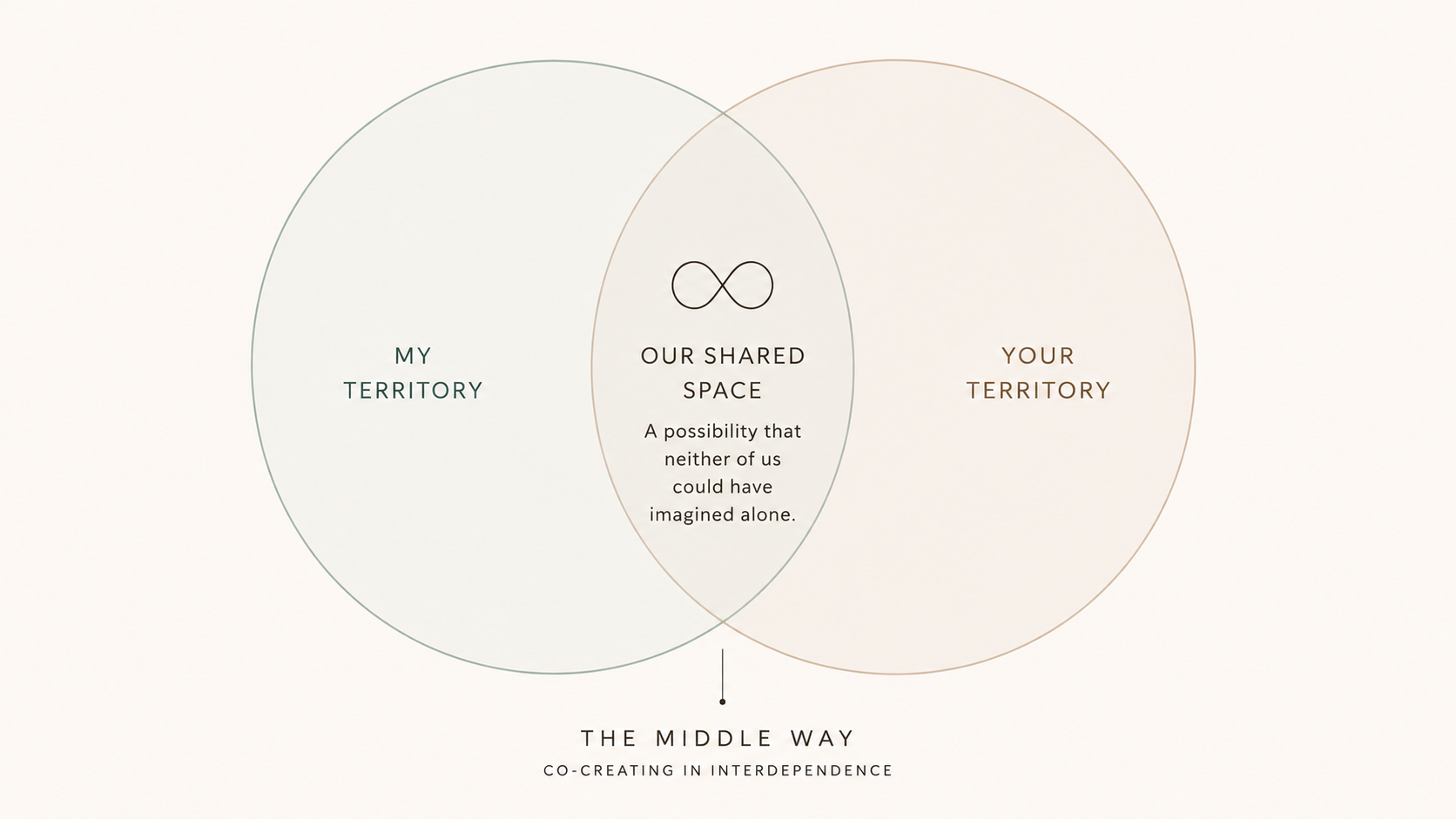
Today I picture it as two circles.
There is my territory.
There is yours.
And there is their intersection.
I do not have to leave my circle to inhabit yours.
You do not have to abandon yours to enter mine.
And yet, at the meeting point, a third space can appear.
Neither my project enriched by you.
Nor your project broadened by me.
But a possibility that neither you nor I could have conceived alone.
The third way perhaps requires two beings grounded enough in themselves to be able to enter a “we” without having to lose themselves in it.
From dependence to interdependence
This third way is not a compromise.
It is not about each one giving up part of their vision to find an acceptable middle ground.
It is almost the opposite.
I can remain fully myself.
You can remain fully yourself.
And we can be open enough for our exchange to transform what each of us believed possible.
Stephen Covey called this the Third Alternative: moving beyond “my solution or yours” to allow a third possibility to appear.
This idea had already spoken to me. Today it takes on a far more embodied dimension for me.
There is dependence: I need you in order to exist or move forward.
Then counter-dependence: I break away from you, I rebel, I need no one.
Independence allows something else: I can stand on my own.
And then comes interdependence:
I can exist without you.
You can exist without me.
And yet we choose to create together because this “we” opens a possibility that would not exist separately.
Interdependence therefore asks for not less autonomy, but more.
One must be able to remain oneself in order to truly welcome otherness.
The horse and the rider
Having practised riding, another image comes to me.
There are horse-and-rider duos that sometimes reveal, in an almost overwhelming way, what I am trying to describe.
When I watch Justin Verboomen and Zonik Plus, for instance, I am sometimes deeply moved.
At times, they seem to be one.
One movement.
One direction.
One intention.
And yet they remain irreducibly two distinct living beings.
The rider does not become the horse.
The horse does not disappear beneath the rider’s will.
True harmony comes not from fusion, but from a quality of listening such that each perceives and responds to the other’s movements.
From this listening, trust is born. And from this trust, the possibility for each to remain fully themselves while engaging in a shared movement.
Perhaps it is precisely because they remain two that a third movement can appear: that of the duo.
I myself never went far enough in riding to truly reach that place. I see better today why it is so demanding.
It requires not needing to dominate in order to feel safe, nor abandoning oneself in order to preserve the bond.
Two beings. One shared space. And something that appears between them, which neither could produce alone.
Everything begins with an encounter
To begin with the encounter is to accept not knowing the form straight away.
Not necessarily arriving with a project.
Not having to demonstrate what I have perceived.
I can come with an intuition, a curiosity, simply the desire to discover someone.
Show them a little of my world and see whether they want to come closer to it.
Take an interest in theirs, not to settle there, but to discover what might emerge between the two.
Perhaps nothing.
Perhaps simply a beautiful conversation.
Perhaps a possibility neither of us had thought of.
The concrete then comes after the encounter, and no longer as a precondition for it.
Not filling the space too quickly
When I perceive a possibility, I can very quickly imagine the next ten steps.
This capacity has served me well. I have no reason to give it up.
But I can learn not to use it too soon.
Because if I immediately fill all the available space, where can the other appear?
The third way needs something to remain open.
Not a passive emptiness.
An openness in which the other can bring precisely what I could not have imagined in their place.
At some point, the movement must become reciprocal.
I take a step.
Then I wait.
Does the other take one in turn?
If they move forward, I can move forward again.
I like to picture this movement as a figure of eight, the sign of infinity.
∞
An impulse leaves me, reaches the other and returns.
Then sets off again.
It is not tit for tat.
It circulates.
The interval between two movements is essential. If I hurry to fill it, I can no longer discover what the other would have done spontaneously.
Letting reality inform me
Today I can think:
This is what I see. I may be wrong. I let reality inform me.
This holds when my intuition warns me.
But also when it senses a happy possibility.
Someone comes back spontaneously.
Picks up an idea.
Enriches it without appropriating it.
Brings an unexpected element.
Moves a piece forward.
The momentum no longer comes from me alone.
I no longer need to manufacture the proof that it works.
I can let reality show me.
My place at the table
I no longer want to carry everything.
But nor do I want to create the spark, open a door, connect people, watch an idea come to life… and then gradually disappear from what I helped bring into being.
I know that feeling all too well.
Giving the impulse.
Preparing the dinner.
Inviting the guests.
And ending up with the crumbs.
Today, I want my place at the table.
Not necessarily at the head of the table.
Everyone can bring their share.
But certainly no longer in the kitchen.
I want to be able to initiate without having to carry.
To contribute without erasing myself.
To receive without having to begin by demonstrating all that I can bring.
My place should no longer be the reward for my contribution. It should exist in the encounter itself.
Meeting myself before meeting the other
For much of my life, I was far more identifiable by what I knew how to do than by who I was.
I have probably often sought, without knowing it, to meet myself through the other.
If they understood what I saw, a part of me became visible.
If they recognised my vision, it became more real.
These past months have confronted me with myself in a far more radical way.
I do not claim to know why certain ordeals come into a life.
I only know what the one I am going through is producing in me.
It has forced me to meet myself.
From then on, I need less to ask the other to reveal me to myself.
I can come with my world.
The other with theirs.
And we can discover what is born at their crossing.
What if, for once, everything went well?
This sentence has been with me for some time.
What if I no longer needed to do everything so that things go well?
What if I could initiate an encounter without knowing what it must produce?
What if some led nowhere and that was perfectly fine?
What if others brought forth what I could never have foreseen?
What if someone spontaneously moved a piece towards me?
I do not yet know what form this third way will take in my life.
And that is perhaps precisely what is changing.
For once, I do not need to know in advance.
∞
The third way does not ask me to give up acting.
It asks me for something far newer to me: to stop doing alone what, by its very nature, can only be born of an encounter.
That kind of encounter cannot be manufactured.
It is born of a resonance and an availability — mine and the other’s, at the same moment.
And perhaps it is precisely in that space left free between two beings that what neither could have imagined alone can appear.