What allows the new to emerge?
Recently, while sharing a post by an expert in business succession, another question came to me: what do we pass on along with the visible heritage?
Recently, while sharing a post by an expert in business succession, another question came to me:
What do we pass on along with the visible heritage?
A business passes on titles, contracts, financial value. But also a history, a culture, relationships, habits, loyalties, sometimes unspoken things.
These two perspectives are not in opposition.
We are simply looking at the same thing from two different places.
And from there, another question appears:
What can emerge from the meeting of two perspectives that neither of the two would have imagined alone?
When an idea becomes "me"
It seems simple.
It is far less so in reality.
We easily identify with our ideas, our convictions, our expertise, our projects. They sometimes end up taking part in the answer we give to that age-old question:
Who am I?
From then on, when another perspective arrives, it is no longer just one idea meeting another.
Something in our identity can feel threatened.
So we defend our vision. We try to convince. We sometimes try to fit the other into our frame.
And the encounter becomes a battle in which someone must be right.
I have often encountered this in my professional life.
People came seeking my experience, my opinion, sometimes offering to make me a partner in a project.
As soon as my perspective opened a space that went beyond the frame already imagined, I would sometimes perceive, explicitly or between the lines:
Let's not spread ourselves too thin.
Or again:
Put yourself at the service of the project.
It was not necessarily a devaluing of what I brought. On the contrary.
One could acknowledge the value of my experience while wishing it to be exercised within a territory already drawn.
And I have probably done the same thing myself.
When I developed Sequoia, I had a very strong vision of what I wanted to create. When I felt it risked being reduced or diverted, I could become very categorical in order to preserve it.
So the question is not who was right.
It is perhaps more interesting:
How do you hold a vision without clinging to it to the point that no other can truly meet it?
A meets B
Stephen Covey spoke of the Third Alternative: going beyond the opposition between my solution and yours to bring a third one into being.
That idea accompanied me for a long time.
Today, I would phrase it differently.
A may not need to become B.
B does not need to win against A.
And their encounter does not even necessarily have to produce a C.
It can open C₁, C₂, C₃… possibilities that were contained neither in A nor in B.
This question extends those that occupied me in my previous explorations. I wondered where the outside world ended and where we began. Then what we truly inherit.
Another question now presents itself:
what allows something that did not yet exist to take shape?
Perhaps we must begin by making room for it.
Yet we have an almost opposite habit: faced with a situation, we very quickly seek to define the problem in order to solve it.
What if, in doing so, we sometimes narrowed the field before even looking at what was trying to appear?
What if there were no problem?
We have learned to solve problems.
We have even become remarkably efficient at it.
Faced with a situation, we ask:
What is the problem?
Then:
What is the solution?
This is obviously indispensable in many circumstances.
But what happens when we automatically apply this reasoning to human beings, to organizations, to societies, to the living?
Before even finding the solution, we have already accomplished a considerable gesture:
we have decided that there was a problem.
What if we started a little earlier?
Before naming.
Before cutting up.
Before solving.
Simply:
What is happening here?
And if what we call a problem were only the part we manage to see from where we stand?
The walls
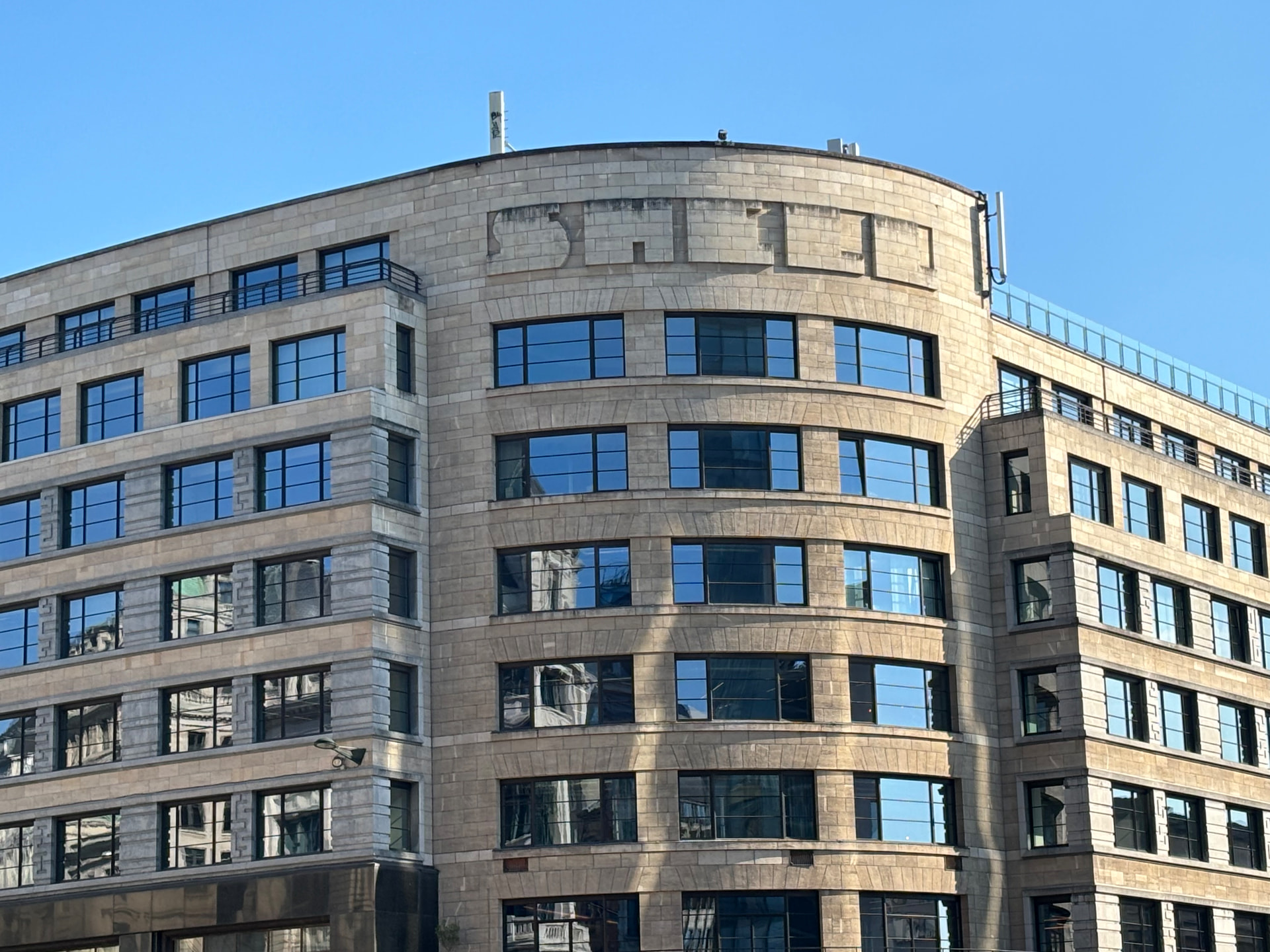
This question brings me back to a very concrete place: Central Gate, the former Shell building in Brussels, built in 1934 by my great-grandfather Alexis Dumont with the architect Marcel Van Goethem.
Among the buildings my great-grandfather took part in, that is the one that drew me.
Long before I really knew why.
So I searched.
This search led me to archives, correspondence and elements of my family history, but also to a story much larger than my own.
Some of my discoveries are factually established.
Others remain intuitions.
Among them, one intuition has never really left me: documents belonging to my family may have been hidden within those walls during the war.
I don't know if it's true.
At the time, when I spoke about it to the building's owners, I had simply mentioned a family memory.
And I wanted to go and see.
Literally.
Open the walls.
I could have gone much further.
Seek out the experts, fund the studies, pinpoint where to open, gather more evidence, build an ever stronger case.
I know very well how to do that.
I could once again have become the orchestra, the conductor and the super-conductor.
I would have invested time, energy and money to bring together, on my side, all the conditions I could bring together.
But one was missing, a fundamental one: the encounter with the person on whom the decision to open the walls ultimately depended.
And to try to obtain that encounter, I would have had to start convincing again. Following up. Pitching. Demonstrating. Proving that this story deserved to have a door opened to it — or, in this case, a wall.
Yet I no longer wanted to convince.
I did not yet know very well what I wanted to do instead. But I knew I no longer wanted to spend my energy contorting myself to obtain from the other the movement I needed.
So I stopped.
Not only trying to open the walls.
I stopped searching outside.
The walls remained closed.
And curiously, that is when my search began to open something else entirely.
The gaze turned around.
No longer only toward what might be hidden in a building, in archives or in family history, but toward what this quest itself was touching in me.
I had not found what I was looking for. But the search had changed direction.
Creating the conditions together
This shift led me elsewhere.
Toward other questions, other encounters, writing, images, stories, connections.
I was looking for something in a wall.
I certainly had not planned what would come out of it.
And perhaps that is where my way of looking at things changed.
For a long time I could see very far, then almost immediately imagine all the steps needed to reach what I saw.
Sometimes to the point of trying to take the steps that belonged to others as well.
Today, I am more interested in something else:
creating the conditions without claiming to produce the result myself.
That does not mean no longer having a vision.
Nor giving up acting.
Nor waiting for things to happen by themselves.
But perhaps doing what belongs to us without deciding in advance what must come of it.
And when it comes to creating with others, something more is added.
We do not create the conditions for something together by asking one person to single-handedly build the ground onto which the other might agree to come.
An encounter supposes movement on both sides.
And in reality?
I sometimes look at the world around us and find it deeply damaged.
And yet, we have probably never had so much knowledge, so much expertise, so much computing power, so many technologies and solutions.
So perhaps we could, from time to time, resist for a few moments our formidable capacity to solve.
Leave a little space for what we had not planned.
I don't know what will emerge from that space.
But perhaps that is precisely why it is worth leaving it open.
What is my way of looking concretely preventing me from seeing?
This reflection belongs to a broader inquiry — Let's search together.
Also worth reading: Let's search together · Where does the outside world end and where do we begin? · What do we really inherit?